


Two years after crews broke ground, Central Emergency Service’s largest station now has a new home. The community, Kenai Peninsula Borough and station employees celebrated with a ribbon cutting last week.
Walking through the front doors of the sparkling Station 1, it looks a little sparse – for now. Natural light shines on a massive blank wall. Roy Browning says that’s where the photos will go. He’s Central Emergency Services’ fire chief, and says they plan to prominently highlight the long road to the organization’s first-ever custom built space.
“The display out here in the lobby will be a photo history of, basically from the volunteer department to a city department, and then to a borough department, and then adding all the other service areas on that,” he said.

The new and old stations are a stone’s throw away from one another, and were built around similar purposes. But in terms of design, layout and functionality, the difference is night and day. The old Station 1 was initially built as a community hall in the 1950s. As the central Kenai Peninsula’s population grew, so did the demand for emergency services.
When CES got its start, Station 1 handled between 300 and 400 calls per year. Now, the borough estimates the annual call volume has increased tenfold – to around 3,000 calls per year, 70% of which are answered by Station 1.
To keep up with the growth, the station was added onto, and then again. And again. The result was a decades-in-the-making hodgepodge of spaces that CES eventually outgrew. That’s how a proposal for a new fire station ended up in front of voters almost four years ago.
In 2022, Ballot Proposition No. 3 asked service area voters for permission for the borough to incur up to $16.5 million dollars worth of debt to build a new station. To pay off that debt, property taxes would increase by $36 per $100,000 of a property’s assessed value. The result was overwhelming, with two-thirds of voters coming down in favor.
“We're very grateful that they supported (it),” Browning said. ‘They saw the priority that has been placed, you know, on public safety and helped us out with the bond and everything all these years.”
Soldotna’s Blazy Construction was the low project bidder and built the station for around $18 million. When costs spiked after the bond passed, the Kenai Peninsula Borough Assembly chipped in another $5 million.


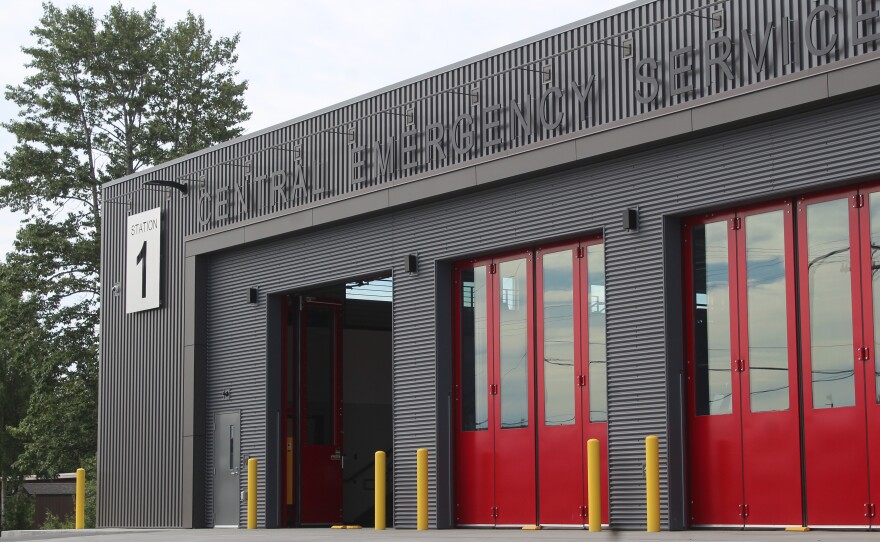


In many ways, the new station is an upgrade. Firefighters have their own rooms. A dedicated gym means crews no longer work out in the vehicle bay. And a multi-purpose conference room is big enough to accommodate every employee at once. There’s also a fireman’s pole – the agency’s first – and keycard access to storage rooms, as well as a spacious kitchen and even a home theater.
Browning says quality of life for agency staff was a big consideration.
“Being on 24- and 48-hour shifts, it's just that home environment when they're not on their emergency call,” he said.
But cosmetics are just a perk. Efficiency and functionality are baked into the station design.
Browning says the flow of the decontamination area is a good example. From the vehicle bay, firefighters returning from a call can go straight into an adjoining laundry room with industrial washing machines. Those are next to dryers, which lead into a locker room full of cubbies stuffed with backup gear. In the old station, lockers shared a space with the firetrucks on the bay floor.

And Browning says the vehicle bays are bigger, too. At the far end, a truck is already hitched with a boat, ready to deploy for a water rescue. The old vehicle bays weren’t long enough to park both at the same time. Adjoining rooms include a tool shop and a hose-drying tower with a full staircase that doubles as a drill wall on the outside for ladder training and rope propelling.
The perks of the new station won’t just be felt in Soldotna, Browning says. That’s because Station 1 is a sort-of hub for Central Emergency Services’ other four stations in Sterling, Kasilof, Kalifornsky and Funny River. Ambulance drivers from other stations, for example, restock at Station 1 between dropping a patient off at the hospital and returning to their home base.
The station brings CES administrators to the same building, too, which is where he thinks service area residents will benefit greatly.
“We designed it for the future, and we're here to take care of it,” he said. “Having us under one roof definitely is an advantage, or definitely something that makes us be able to just deliver the services better.”
There’s still some work to be done at the new station – certain furniture is en route and construction workers filed in and out of the building Thursday. But staff were officially moved in by the Fourth of July and Browning says they’re ready and waiting for the next call.

